Tuesday, December 13, 2022

That December Sunday

On that first Sunday in December of 1941, my 9th birthday was a few months away.  I was in my father’s pharmacy and yes it was on a corner. The drugstore air I was breathing, is no longer reproducible without crawling into a time capsule. The vapors included crude drugs (long-since fallen into disrepute) escaping from apothecary jars, mingled with cheap perfume and assorted emissions from the soda fountain which included a sandwich board where an egg salad on toast including a coca cola went for 19 cents.

Into this intoxicating brew I was filling up the rack of cigarettes: Old Gold, next to Pall Mall, next to Chesterfield. The temperature had dropped, wind was gusting but no white stuff yet. Noble’s lot was beginning to get their first shipment of Christmas trees down the block. I was a dreamy kid remembering last year’s snowball fight and anxious to use my hand-me-down flexible flyer. The radio was playing a football game when the announcement interrupted the play-by-play with news of the Japanese attack on Pearl Harbor.

I didn’t know Pearl Harbor from Pearl Mittledorf, my friend’s sister, but the gravity in his voice sent shivers from which those reassuring and familiar inhalations were no match. Suddenly our collective breaths were charged with a gravity unknown to me. Even my father with usually unshakeable calm seemed to lose his tranquility as if the torsion balance scale could not find a point of equipoise.                                                                             

I had since dismissed the notion of Santa, elves and ho, ho, ho, along with the tooth fairy. Times were tough with breadlines still in the headlines. My mother was always in combat mode doing battle against daily dragons. I grew an enormous inch that day as if I had passed some threshold of initiation into an adult world.

The next day at P.S. 99 we listened to President Roosevelt’s intonations of those words, live in infamy, describing this new state of war. Years later I learned that Winston Churchill danced in jubilation over our entry into W.W. II, just in time.

My universe becomes black and white, life and death. Blood on the snow. Maps on the front page showed dark and light divisions with arrows. It was the winter of new words. Panzers, War Bonds, blackouts, air-raid wardens and a different kind of draft. Saboteurs, Blitz and refugees, U-boats and convoys. Praise the Lord for the White Cliffs of Dover and then Pass the Ammunition, I’ll Be Seeing You and the Fuhrer’s Face.

The war moved inside me. I learned whom to hate. Moral absolutes leave no room for doubt as interred Japanese-Americans found out. It was either snowing or it was not. Dark days. Bright lights.


Sunday, December 11, 2022

Eulogy

My friend has asked me to write his obit. He is my age and he’s not even sick. But he doesn’t want to miss out in case of his untimely demise as if he’d be late for his own funeral. I shouldn’t say obit; it’s more like a eulogy. Why do we save our best words till it’s too late? In a perfect world there would be a rehearsal.

So, I did. I wrote it and he said he loved it which shows he is too easy to please or too forgiving. I cannot bring myself to speak of him in the past tense. Stan is my oldest friend whom I regard as a near-brother even though we’ve seen little of each other since 1950, living on separate coasts. The Atlantic is gigantic and the Pacific is terrific but they haven’t washed away the bond forged long ago.

We met in kindergarten. Maybe I was a wardrobe monitor and he had the same brand of galoshes. Or perhaps we built a city together with blocks. I could say anything but Stanley would call me on it. We are each other’s fact-check. Though facts are no longer an operative word. Versions are more apt. Those awful wonderful humiliating exuberant moments are seen with kaleidoscopic eyes. Memories have long ago lost verisimilitude. They’ve become endearing moments in the blockbuster film of our lives with episodes so unlikely they must be true.

Growing up was clumsy. We followed odd-looking people for blocks at a time until it dawned on us that we were the odd ones. Stan reminds me how we preferred slices of bologna to candy like normal kids. Somehow life was sweet enough as evidenced by multiple cavities even as we discovered it was also full of baloney.

Stan’s professional life as a biochemist was notable in spite of our misspent youth. I will leave that for others more familiar with his contributions.

We weren’t very fluent in the language of flirting but we counted ourselves among the politically righteous and were ardent in pursuit of careers on the basketball court. One winter day, with temperatures below zero, we climbed the chain link fence with a snow shovel in tow into our school yard. We cleared the area around the basket to perfect our jump shots. All right, it was actually in the low thirties but it felt below zero with the wind chill.

Nobody is second banana in the movie of their life even though there were few heroics, no dragons slain, double-agents, rafts down the Mississippi or near-death experiences. We were, however, possibly first among our peers to get stoned at a concert. The event was Paul Robeson at Peekskill in 1949 and the stones were thrown by a crazed mob through the window as we took cover on the floor of the bus among broken glass. These were likely the grandparents of Q-Anon folks who are now merely following in their family tradition.

Stan and I went on a ten-day bike trip through five states in New England that same summer or was it the next? We must not have budgeted well since I recall splitting a Clark bar for dinner one night. We stayed at youth hostels or in barns. Unaware that Newport R.I. was above our pay grade we bought box seats overlooking the stage for a play on opening night, dressed in T-shirts.

We have albums of stories in our heads which get embellished like polished stones in each telling. The kinship between us has survived the decades, testimony to our shared values and a genuine affection. Could it be we instinctively knew that eighty-five years ago? All that has followed is a reenactment of galoshes and a city of blocks, the paradise we never quite left.

All these tableaus do not convey the measure of the man. Stanley was and is a gentle soul, cultured and with undiminished smarts along with a sense of humor we must have created together. Who else would laugh at my jokes?

With perfect pitch Stan sang in a choral group while I was consigned to the back row as a listener. I have been listening closely ever since. When we are ready for our afterlife, I expect him to sing us to heaven. I’ll start harp lessons any day now.  


Thursday, December 8, 2022

Honk If You're Hunkering

( Since the flu is having its way with us and new variants are busily mutating as we speak, in defiance of our best science....)

Here we are hunkered down. I never expected to be hunkered. Nothing has prepared me for this. Up until ten months ago, I doubt if I’d ever used that word. But now I’ve got a hankering to hunker.
Hunkered has a dank, down-in-the-trenches feel to it. It’s low-down and dirty. You don’t just hunker, you hunker down as in sunk or dump, even slam-dunk. Kerplunk!

I’m now in my subterranean laboratory hunkered and bunkered with a bubbling cauldron looking for the elixir of life.

Monks were hunkered; they called it cloistered. Not a bad place to be during the plague with a direct line to God in one of his tantrums.
From the depths of the well you can best see the stars. Whoever said that I’ll take his word for it.
Hunkered harkens to muck and mud. Mississippi mud as in Huck Finn. It's all hunky-dory with me.
You don’t have to be a hunk to be hunkered. We’re all in this together huddled and bubbled six feet apart.
One can get in a funk hunkering; even go bonkers while bunkering but it's all for the greater good.
I only unhunker to the laundry room or the trash can. If I ever throw out our clothes or wash the garbage it’ s time to leave this orb.
Wonks do it. People from the Bronx do it. Spelunks do it. Even educated punks do it. Let’s do it. Let’s all hunker-down. Insufferable uncles when they're drunk do it. Archie Bunker does it. Folks from Chunking do it. Even genetically modified skunks do it. Let’s do it. Let’s hunker-down.

Monday, December 5, 2022

Matters of Life and Death

Mortality is that concept beyond our imagining. It shadows us from first breath to last gasp and we spend our life giving it the finger or persuading ourselves it surely doesn’t apply to us. We live that car chase always eluding death and its speed bumps until it catches us with severe tire damage to our vitals.

These past ten days I have been told of the death of two friends. Sylvia was in her nineties having endured more slings and arrows than most.  Brad left the world still in his creative prime. I mourn them both.

After a heart attack and lingering cardiac and pulmonary pressure along with a series of other bodily insults my ex-wife Lyn knocked on death’s door asking for an exit from this mortal coil. My daughters said their separate goodbyes on Friday. She died Sunday night in an easeful departing.

Though we had little contact for over three decades I find myself dwelling on those early years; how we discovered the adult world together at age twenty-one. We shared that great adventure having arrived in Los Angeles newly married, and I confident (or dumb) enough to assume I’d pass the pharmacy licensing exam which I did. Lyn and I stumbled and bumbled our way along. By age twenty-nine we were parents of three girls one of whom had special needs. In a sense all our needs are special as we find our way. Looking back, I’m left with an album of memories filled with endearing images.

There’s a man going round taking names. / There’s a man going round taking names. / He has taken these people’s names  / And has left my heart in pain. / There’s a man going round taking names.

In this confrontation with the end of life we come away in a deeper place as if mortality wakes us up to the full measure of life. Priorities get rearranged and each moment becomes a blessing. Death is no match for love and the rhapsody of life. Go ahead, squeeze the orange, pits and all, new life awaits in the seeds and there is juice yet to be slurped.


Monday, November 28, 2022

Walking With Ponder

Brisk this morning or so it seemed inside. Outside, less so. With Janice as my Sherpa guide I climbed the Himalayas which is a slight incline on the last leg of my eight blocks around the neighborhood. I have changed my itinerary from the shady side of the street to catch the eastern sun, dappled as it is from the eucalyptus trees whose bark strikes me as wise and weary.

I’m shuffling along, wearily, with my walker wondering when wisdom happens to my bark. I’m told by my favorite astrologer that I have moved past my third Saturn return into sage-dom. Sounds like the penultimate stop before senility. Of course, I may be the last to know.

Sagacity is a many-splendored thing. There was a time when it seemed like a simple matter of following the syllogisms. If this, then that. Proof has the allure of elegance. But a gate slams shut with the finality of some crusty absolute.

Questions are better answered by new questions marks. Sentences yearn for exclamation points.

At some point I discovered a dimension that knows of no logic. I would rather poke my lantern into the realm of the inexplicable, that bubbling cauldron of the imagination. The heart that won’t behave beats out of its head. Words and images appear with no return address. I take my cue from the wizened eucalyptus discarding old skin as it reaches for a new season of treeness.

Of all the trees along my path these are naked sculptures caught in the act of their birthing. Like us they are a work-in-progress.

I’m walking slower today shedding exhausted, limp ideas. Dialectics clash and slough away. The sidewalk is a lesson in upheavals. The flowering tree remains nameless to me and that is all right.


Friday, November 25, 2022

The Artist and the Thanksgiving Table


 Believe it.............................................or not.

His art gave us nothing less than idealized Americana. Yet his life was an American enigma.  

He was scorned by the art world, particularly critics, but praised by William de Kooning and collected by Andy Warhol. He studied at the Art Students League in New York City. For years he was a patient and close friend of the psychoanalyst, Erik Erikson. He joined the cause for nuclear disarmament and civil rights movement. His painting of a 6-year-old Black girl breaking the color line accompanied by U.S. Marshalls against a wall of KKK epithets became an iconic image of the school integration struggle. We share a first name and one other curious event.


In 1957 both Norman Rockwell and I attended a college extension course, albeit in far different parts of the country, called Discovering Modern Poetry. He married his teacher. My class was under the auspices of UCLA and held at Peggy’s house. I remembered her when we reconnected 23 years later and began my life part II. But I digress.

He was a frail man raised at a time when Teddy Roosevelt promoted the robust, athletic type as a male ideal. His work often showed older men and boys caught in embarrassing moments, projections of how he saw himself. He had three wives but was probably a closeted gay man. Few of his paintings depicted women at all.

At age 22, in 1916, Rockwell’s illustration made the cover of America’s most popular magazine. There were two weeklies with the word Saturday in their title. One was the Saturday Review of Literature. Readers of that literary magazine most probably looked down on the Saturday Evening Post which employed Rockwell until 1963. The Post was vigorously anti-New Deal and isolationist until it wasn’t supportable. 

During the war Norman Rockwell offered his Four Freedoms posters to the War Department and was turned down. After they appeared on the cover of the Post the government swallowed its pride and embraced the work reprinting them by the hundreds of thousands. Rockwell also created Rosie the Riveter in 1943, the iconography of the time.

Along with Edward Hopper, who captured urban desolation, and Grant Wood whose American Gothic spoke of rural life in facetious tones, Rockwell’s work largely depicts a vanishing Americana of small-town New England. He ranks as a first-class draftsman but was he an illustrator or an artist? Now that I’ve posed the question I want to discredit it.

Is it art, might also be asked about work hanging in many contemporary galleries. If art is defined as that which confounds, agitates and shifts perception then Rockwell could be consigned to the category of illustrator. He was not only dismissed by the Modernists but regarded as the bourgeois antithesis of what they were all about. While the New York School veered toward reduction and negative space Rockwell’s canvases were almost cluttered.

But I abhor categories. Blurring the lines between is more fun. I’m all for inclusion. It can be argued that much of minimalist art is elitist, soulless and opaque. At least Norman Rockwell knew how to connect. His genre work offered immediate recognition. The first half of the 20th century was a time when immigrant America had to invent itself and he found the populist links and rituals. His genius was to create a human drama in the moment. Even if we never found our real selves in the scene, our idealized self would know the way around. And perhaps his homey representations were not as benign as at first glance.

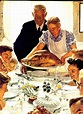
One of his most famous pictures is Thanksgiving dinner as the representation of Freedom from Want. (Another term for economic freedom) Those gathered around the table are not looking at either Grandma or the turkey. None are bowed in prayer giving thanks and one central figure has a look on his face as if he is only begrudgingly present. This could have been Rockwell himself. He was estranged from his own nuclear family as he took vacations with his male model and friends. Rockwell is less a realist than a fabulist.

Perhaps Rockwell can be compared to Robert Frost. In their separate art forms each took a path less traveled by avant-garde movements. Their words and images will endure as Yankee-bred art whose narratives welcome the reader and viewer and are deceptively familiar but demand repeated visits. Is it Art? I say, Yes, make room for him.

Tuesday, November 22, 2022

The Day Wales Tied the U.S.

Have a pear-apple. Apple and pear tied in the pulp of the matter.

My Covid test is indeterminate. Was that really a pink line?

Some of Trump's toadies are denouncing him.

Others roll up their sleeves and approach him on their knees.

Putin bombs Ukraine to Smithereens.

Forty million Smithereens answer back.

Microbes, guns, carbon dioxide. Have a nice day.

French toast at 4 A.M. with maple syrup. Covid is neutralized.

Mr. Smith comes to the Washington swamp of Foggy Bottom.

Broken-field runner fumbles in Georgia. Let us open our hymnals.

Gluttony and Sloth vs Avarice and Malice. No contest.

Men put balls in holes. Where there was nothing there is now something and then there is nothing again.

Wales gave us Dylan Thomas. We gave them Mark Zuckerberg.

Raise the damn goalposts or lower the field. 

Fans don't love zero-zero. But the rest of us like the equipoise.